2009-12-13

Cufflinks 2009


Finally a post to help y’all with your Christmas shopping for MEN! I think they deserve some jewelry-attention. Caroline van Hoek Gallery is currently hosting an exhibition devoted to cufflinks, traditionally worn by men. Again, I’ve chosen two works, this time by two different artists.

The first cufflinks are by Lisa Walker, and linked with nostalgia, since she has used ‘vintage’ playmobil parts for her contribution to the exhibit. I still remember from my own childhood, that all the boys in my class played with playmobil. Those boys have now grown up, and are probably the men that could use some cufflinks. By wearing these, they can keep their inner child alive.

A whole different kind of historical connection is found in the second pair of cufflinks of Willemijn de Greef. She has worked with the shape of ‘Zeeuwse’ buttons, a traditional kind of button from the South-West of the Netherlands. The buttons were used for all kinds of adornment, and were also worn by men as a sort of belt-buckle. This explains their size, the biggest half of the cufflink is as big as a medium sized adult hand. The form is hollow, so not as heavy as it looks. It is an invitation for men to wear a part of Dutch history in the shape of contemporary jewelry.

This exhibition is showcased on Klimt02.

2009-12-07

Than oars divide the ocean, too silver for a seam


Not one but two pieces this week, because they are so wonderfully done.
When Leslie Matthews stumbled upon a beautiful collection of 19th century Dutch clay pipe bowls, she was drawn to their small, delicate shape. Keeping them in mind, she created a whole series of silver forms. Their surface is embossed with Japanese rice paper to give them their fragile impression. Each form is inspired to complement the following one, as the two above show so well.
The title is a line from a poem by Emily Dickinson, who is a favorite of Leslie Matthews. She lives in Australia, so the sea is never far. I love how the forms are elongated by the waves of the silver necklace. And also how the color of the silver, reflects the different colors of the ocean, white for the foam of the waves, and black for its’ endless depth. On all these different levels,they really interact with each other! So for me, the work triggers an emotional response, which what Leslie Matthews is interested in.

2009-11-26

Bull ! 2008


I have been admiring Felieke van der Leest’s work for quite some time now. When I saw her upcoming exhibition on Klimt02, it was just what I need as an excuse to write about it. The exhibition “F.I.B.S. (Festival International de BĂȘtes Sportives”) starts on the 27th of November until the 13th of December at gallery Deux Poissons in Tokyo.
The title of the exhibition is French for ‘international festival of sporty animals’. It refers to the Olympic games that were held in China in 2008.
This brooch is called Bull ! 2008, and refers to the Olympic sport of Archery. Here, the bull, is the ruby nose of a tiger. The perfect golden arrows, all the neatly sewn green sequins and the beautiful crochet work show that the brooch has been very well made. If the tiger doesn’t attract people’s attention then its sparkle will.
Tigers, are a protected and endangered species. In China, they are a symbol of power, energy and bravery, as well as good luck. Their skin is a status symbol and their bones are said to have medicinal power. Unfortunately many of them are shot for these reasons and not much is done by Chinese officials to stop the killing. The very surprised looking tiger in the brooch has just been hit by six arrows!
It is hard not to take the message seriously.

2009-11-18

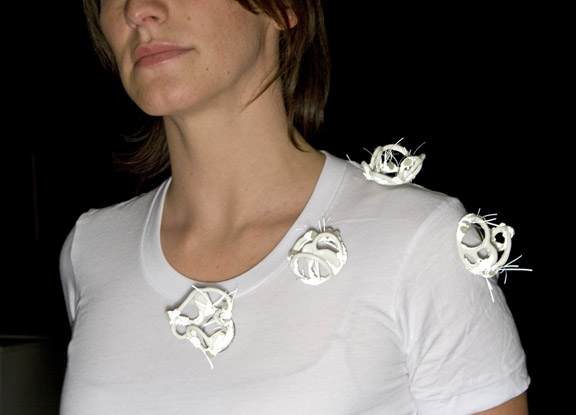
Biopsy II


In a lot of cases a biopsy is done with a hollow needle. This means that the sampled tissue that comes out, is round on the outside. What the sample looks like under the microscope, depends on lots of things. I could not have imagined it looking like this brooch ‘Biopsy II’, by Islay Taylor.

One of the most striking things about this brooch is the reflective property of some of it. All the rougher parts, and the wires sticking out, reflect light. This is shown in the top photograph. It must have been something very dangerous coming out of that body! No matter what the medical reasons are, I love the way it looks. The rest of the brooch is white, still, not a color you’d expect of a piece of tissue. But I don’t mind, it works really well in combination with the reflective bits. So beautiful, to see the color white used as the darker part of the piece.

Another interesting thing about this work is the suggestion that something has been taken from inside the body, and then it is worn outside of the body. It is all about the luminescence of inner beauty!

2009-10-31

Chestnut animal


There is some thing about fall that seems to cross the border of countries, languages and traditions. Children everywhere love the magic of chestnuts. My sons have come home with so many this fall, they could hardly carry the load. I also remember collecting them as a child, taking them everywhere, comparing mine to the ones my friends had collected and, of course, making little animals out of them.
Now I have found proof of it happening in places far away from Antwerp and the tiny Dutch village I grew up in. It has come in the shape of this very cute pin ‘Chestnut animal’ by Estonian jeweler Ketli Titsar. Her fond childhood memories of the things she did with chestnuts have led to her creating this jewel. It is part of the collection ‘Homesickness’, but with so many chestnuts around, the lucky girl doesn’t have to be homesick anywhere!

Ketli Titsar is one of the European jewelry artists selected for ‘Walking the gray area’, an international jewelry project. For this project, 20 European and 20 Latin American jewelry artists have been coupled, to work on a collective exhibition. In order to bring everybody together, the ‘Walking the gray area’ blog has started. It is an interesting way for the artists to communicate, and, at the same time, share their story with the rest of the world. The exhibition will be presented at the Gray Area symposium, taking place in Mexico City in April 2010. To be continued……..

Walking the gray area’ is also featured on Klimt02.